
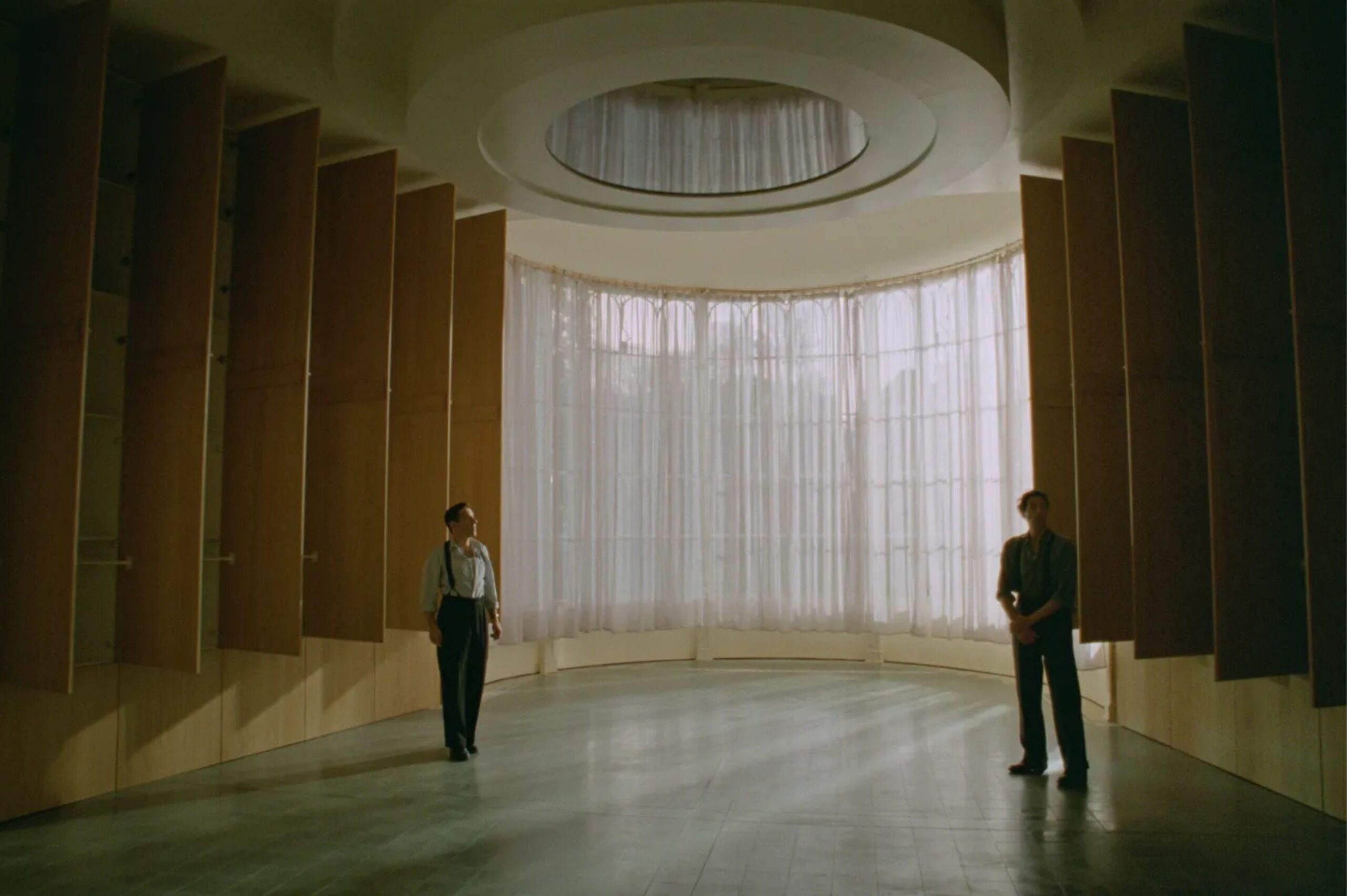
1. Sentimental Value | Joachim Trier
2. The Brutalist | Brady Corbet
The Brutalist centers on an architect’s life: his professional ideals, personal trauma, and reinvention in a new country. The film uses architecture as subject matter and a thematic lens. The design challenges faced by its protagonist reflect broader questions about identity, modernism, survival, and the role of architectural practice in transforming societies.
1. Heydar Aliyev Center – Zaha Hadid
1. Heydar Aliyev Center – Zaha Hadid
3. Parasite | Bong Joon-Ho
In Parasite, architecture is fundamental to the film’s social critique. The narrative revolves around two contrasting homes: a semi‑basement apartment representing the working-class Kim family and an expansive modernist house for the wealthy Park family. The design of these spaces—their volumes, light access, levels, and circulation—visually communicates inequality and power dynamics. The Park house was specifically designed as a set to embody wealth, openness, and control, while the Kim home feels cramped and exposed.
4. I’m Still Here | Walter Moreira Salles Jr.
I’m Still Here (“Ainda Estou Aqui”), directed by Walter Salles, is a historical drama set in 1970s Rio de Janeiro. The film focuses on family life inside a middle‑class home during Brazil’s military dictatorship. While not a film about architecture per se, the design of everyday domestic spaces—the house, the living areas, and the interaction with the city beyond—reflects stability and normalcy before political upheaval. The house becomes a space where personal and public histories intersect.
5. In the Mood for Love | Wong Kar-Wai
Wong Kar‑wai’s In the Mood for Love uses interior spaces, including narrow hallways, partitioned apartments, patterned staircases, to emphasize emotional restraint and proximity. The repetitive geometric layouts and the tight framing of domestic spaces enhance the sense of longing and unspoken connection between the characters. Though subtle, the architecture structures the film’s emotional rhythm.
6. Dune | Denis Villeneuve
Dune presents architecture on an epic scale. Production designers and director Denis Villeneuve created physical environments and structures that reflect different cultural values and conditions on Arrakis. The built world draws on brutalism, ancient monumental forms, and minimalism, grounding the futuristic universe in a strong architectural identity. The architecture not only defines place but also anchors the narrative in cultural history and survival logic.
Architecture in film is not passive. It forms the story, sets the tone, and communicates important information about characters and their world. By looking closely at spaces, we see how design can become a storyteller.


